Landscape Lighting Manufacturer vs. Trading Company: A Sourcing Guide for Wholesalers
2026-06-02Author:Qiu, Tina
Choosing between a landscape lighting manufacturer and a trading company can directly affect your cost, product quality, delivery time, and long-term supply stability.
For importers and wholesalers, the question is not simply which supplier offers the lowest price. The real question is: which type of supplier can better support your business model, order volume, customization needs, and after-sales requirements?
This guide compares landscape lighting manufacturers and trading companies from a practical sourcing perspective, so you can make a more informed purchasing decision before placing an order.
Why This Choice Matters When Sourcing Landscape Lighting
Landscape lighting is not just about appearance. Since outdoor fixtures are exposed to rain, UV, soil moisture, temperature changes, and long working hours, your supplier must understand both product design and real outdoor application.
For importers and wholesalers, choosing between a manufacturer and a trading company can affect more than the first quotation. It can directly influence your cost, quality, stability, customization options, delivery schedule, and after-sales support.
Here are the key areas this decision can impact:
Your purchasing cost: whether you buy directly from the source or through an additional intermediary.
Your product quality: how well the supplier controls materials, assembly, testing, and inspection.
Your customization ability: whether the supplier can support OEM/ODM requests, private labeling, or product adjustments.
Your order flexibility: whether the supplier can handle your MOQ, mixed models, or trial orders.
Your delivery reliability: whether production schedules and shipment timelines are under direct control.
Your after-sales support: how quickly quality issues, replacements, or warranty claims can be handled.
Your long-term supply stability: whether the same models, parts, and specifications can be supplied consistently over time.
A trading company may be suitable for small mixed orders or early market testing. But if your business depends on consistent quality, repeat orders, customized products, and long-term supply, working directly with a landscape lighting manufacturer is often the more reliable choice.
Landscape Lighting Manufacturer vs Trading Company: Quick Comparison Table
Before comparing costs, MOQ, quality control, and lead time, it is important to understand the basic difference between these two supplier types.
A trading company does not usually manufacture products by itself. Instead, it sources landscape lighting products from one or more factories and resells them to importers, wholesalers, or distributors. Some trading companies also help buyers consolidate different products, handle communication, arrange inspections, and manage export procedures.
The comparison below gives you a clearer picture of how manufacturers and trading companies differ in real sourcing situations.
Operational Metric
Landscape Lighting Manufacturer
Trading Company
Basic Role
Produces landscape lighting products in its own factory.
Sources products from different factories and resells them to buyers.
Pricing Structure
Factory-direct pricing is usually more competitive for high-volume or repeat orders.
Includes an additional service margin, but may offer convenience through sourcing and consolidation.
Minimum Order Quantity
Often has higher MOQ per SKU because products are made through planned production runs.
Usually more flexible for small orders, mixed SKUs, or trial purchases.
Quality Assurance Control
Directly controls materials, assembly, testing, inspection, and packaging.
Relies on partner factories and may use third-party or pre-shipment inspections.
R&D and Customization
Better suited for OEM/ODM, tooling changes, private labeling, and technical adjustments.
Usually limited to simple customization unless supported by the original factory.
Product Catalog Variety
More focused on specific product lines or materials, such as aluminum, brass, or low-voltage fixtures.
Often offers a wider product range across multiple categories, accessories, and suppliers.
Lead Time Dependability
Has direct control over production scheduling and capacity planning.
Depends on partner factories’ production schedules and stock availability.
Technical Support
Can provide more accurate answers on structure, materials, waterproof design, optics, and installation.
May be less technical and needs to confirm details with the actual factory.
Best Fit
Importers, wholesalers, brands, and project buyers are seeking stable quality, customization, and long-term supply.
Buyers who need small mixed orders, broad sourcing, or early-stage market testing.
6 Key Differences That Directly Affect Your Purchase Decisions
Before making a sourcing decision, it is important to understand the key factors that can impact cost, quality, lead time, customization, and long-term support. The following six differences highlight the areas where choosing a manufacturer or a trading company can directly affect your purchase outcomes.
1. Cost Structure and Pricing Transparency
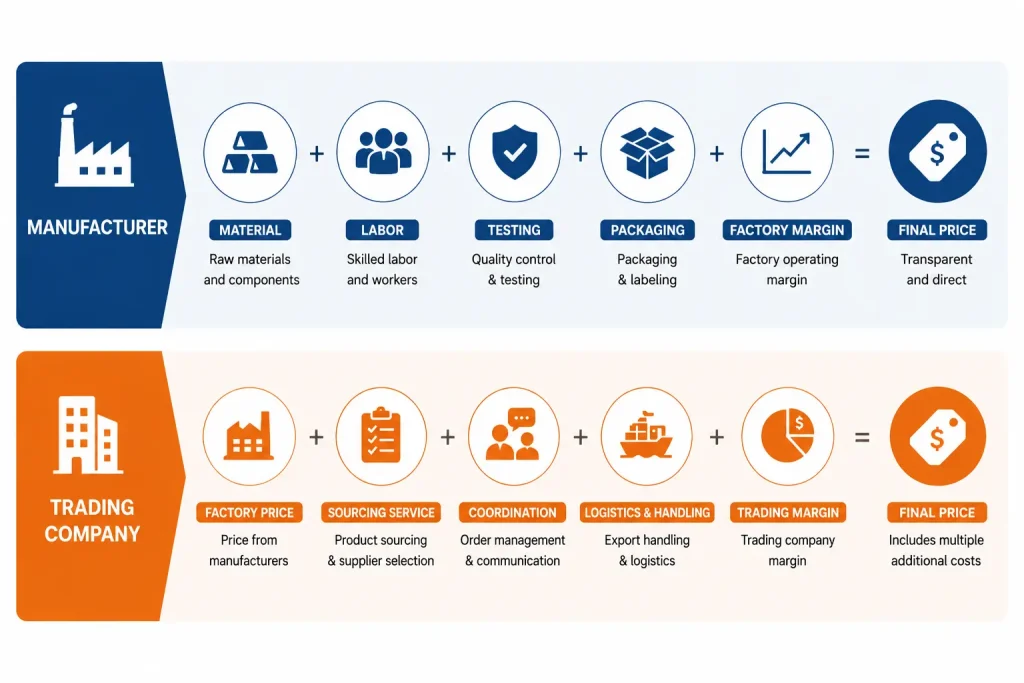
In landscape lighting sourcing, unit price alone rarely reflects the real cost. When working directly with a manufacturer, pricing is usually closer to actual production cost, including materials, labor, production processes, testing, packaging, and factory margin. For repeat wholesale orders, this also makes cost adjustments more straightforward as volume increases or specifications remain consistent.
Trading companies add a service margin on top of the factory price. This margin usually covers supplier sourcing, communication, inspection coordination, and export handling. For buyers managing small mixed orders or multiple product types, this service can reduce sourcing complexity.
However, for high-volume importers, even small unit price differences add up quickly. For example, at 10,000 units per year, a $0.50 difference per fixture equals $5,000 in additional purchasing cost. At $1.00 per fixture, the gap reaches $10,000.
The focus should be on price composition, not just the final number. Evaluate materials, waterproof structure, LED components, packaging, testing standards, spare parts, and warranty support. In many cases, a slightly higher price from a reliable manufacturer can result in lower overall cost and fewer after-sales issues.
2. MOQ, Order Flexibility, and Mixed Product Needs
MOQ is not just a purchasing number. It reflects how a supplier manages materials, production setup, packaging, and inventory.
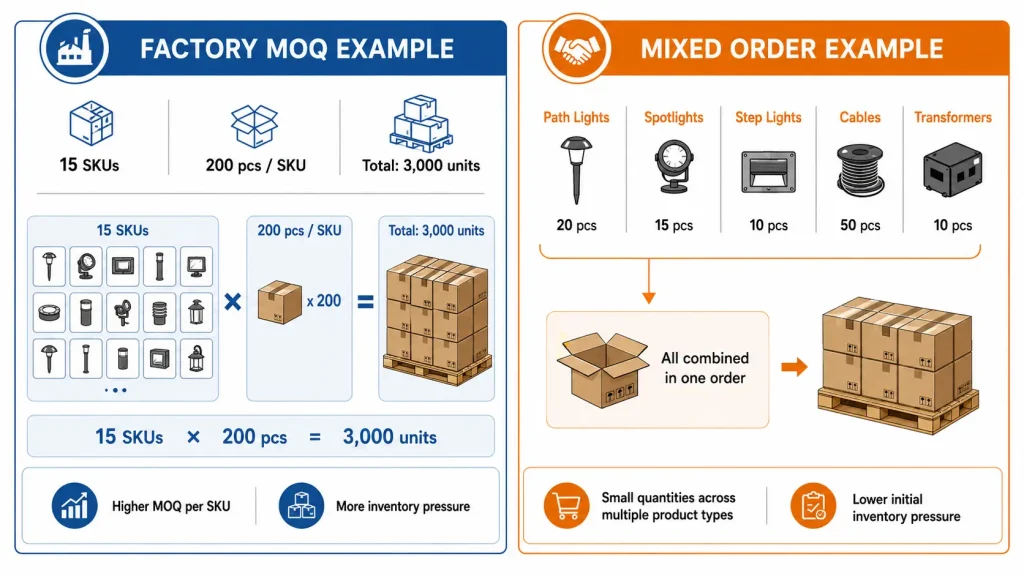
For manufacturers, MOQ is typically tied to each SKU, finish, material, or packaging requirement. A custom brass path light with a specific finish and private label packaging requires material preparation, surface treatment, assembly scheduling, packaging setup, and basic testing. At low quantities, this process is simply not efficient, so MOQ per SKU tends to be higher.
For wholesalers running repeat orders, this is usually not a problem. Reordering the same path lights, spotlights, or in-ground fixtures helps maintain consistency and keeps unit costs stable.
The challenge comes with product testing. If each SKU requires 200 units and you test 15 models, the initial order quickly reaches 3,000 units—before you know which products will perform.
Trading companies offer more flexibility by consolidating smaller quantities across suppliers or using available stock. This reduces upfront commitment, but can introduce inconsistencies in finish, packaging, connectors, cable specifications, or warranty terms.
For early-stage product testing, trading companies are often more practical. For building a consistent, scalable product line, working directly with a manufacturer is usually the better long-term approach.
3. Quality Control and Batch Consistency
Quality control is critical in landscape lighting because outdoor fixtures must handle rain, UV exposure, soil moisture, heat, and long operating hours. A small change in the LED chip, driver, gasket, cable, or surface finish can affect product life and create warranty problems after installation.
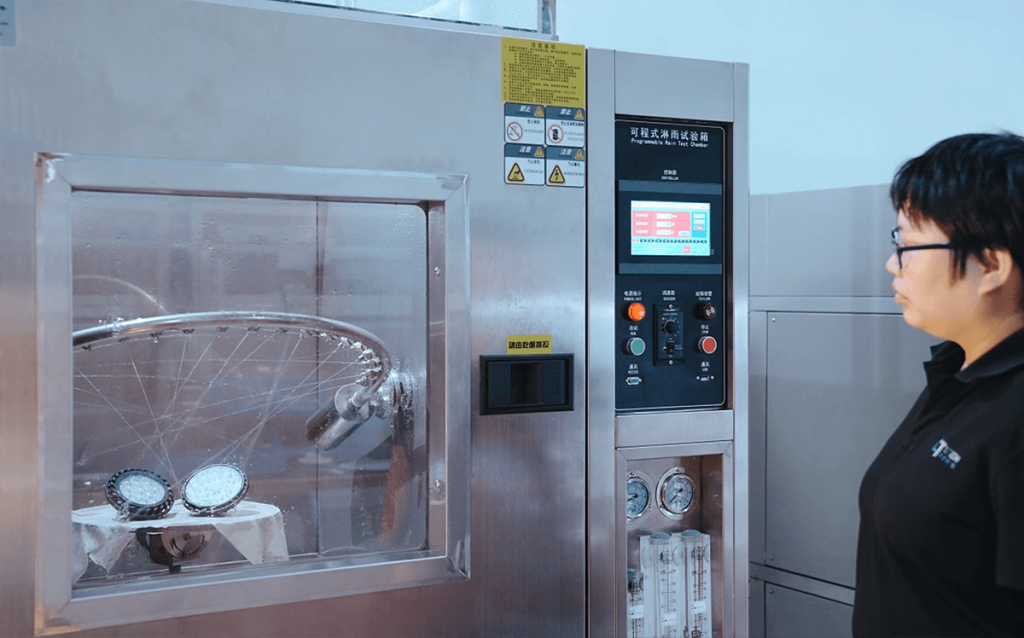
A landscape lighting manufacturer usually has more direct control over quality because production, assembly, testing, and inspection happen inside the same system. Depending on the product type, this may include waterproof testing, aging tests, light output checks, salt spray testing, and final appearance inspection before packing. If a batch issue occurs, the factory can trace it back to materials, production records, or assembly processes more quickly.
A trading company may still arrange quality inspections, but it usually depends on the partner factory’s production control and third-party pre-shipment checks. This can work for standard products, but it may be less effective in detecting hidden changes in components or inconsistent production between batches.
For wholesalers, batch consistency matters as much as initial sample quality. The sample you approve of should match the products you receive in future orders. If your business depends on repeat sales, stable specifications, and fewer after-sales claims, direct manufacturer quality control is usually a stronger advantage.
4. OEM/ODM Customization and Technical Support
OEM/ODM customization is not only about adding a logo to the fixture. For landscape lighting buyers, it may involve changing the housing color to match a product line, adjusting the beam angle for different planting areas, using longer cables for low-voltage installation, changing connectors for a specific market, or developing private-label packaging for retail shelves.
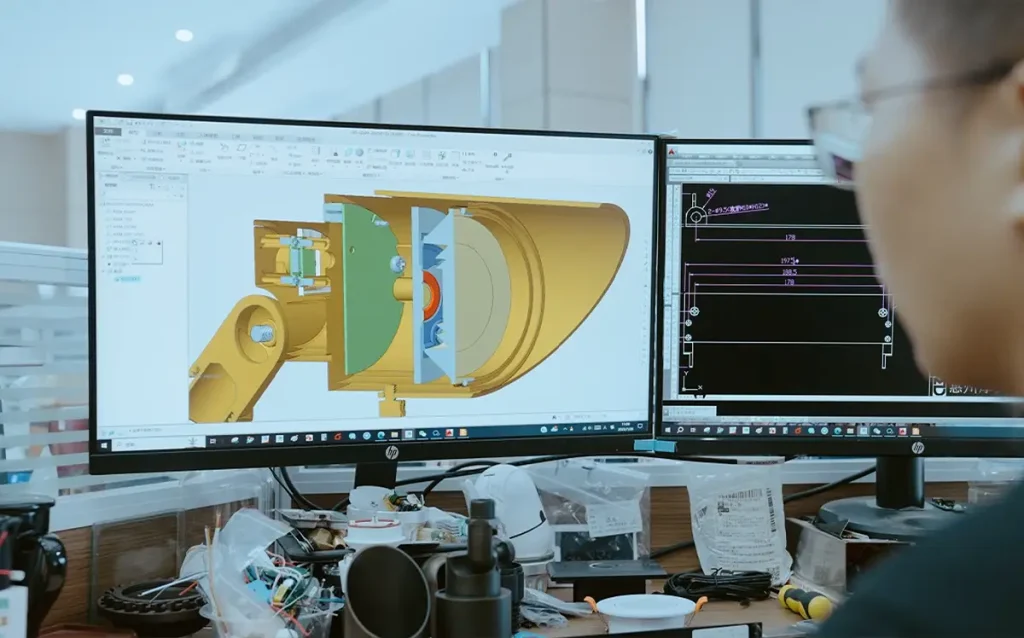
A landscape lighting manufacturer can usually involve engineers early in the process. For example, the factory can check whether thinner housing affects heat dissipation, whether a new lens changes the beam spread, or whether a longer cable creates voltage-drop concerns in low-voltage systems. It can also provide practical documents such as specification sheets, installation guides, product drawings, and IES files for project bidding or lighting layout work.
A trading company can handle simple customization requests, such as logo printing, packaging changes, or color adjustments. But when the request involves structure, optics, wiring, or performance testing, the trading company must confirm details with the actual factory. This extra step can slow down sampling and increase the chance that the approved sample does not match the final bulk order.
For wholesalers building a private-label landscape lighting line, technical support affects sample accuracy, installation performance, project communication, and repeat-order consistency.
5. Lead Time, Production Control, and Delivery Risk
Lead time is a major risk in landscape lighting because orders are often seasonal. Many wholesalers need inventory ready before the spring and summer installation periods. If a shipment is delayed by three or four weeks, the issue is not just late delivery. It may mean missed project deadlines, empty warehouse stock, delayed contractor orders, and lost peak-season sales.
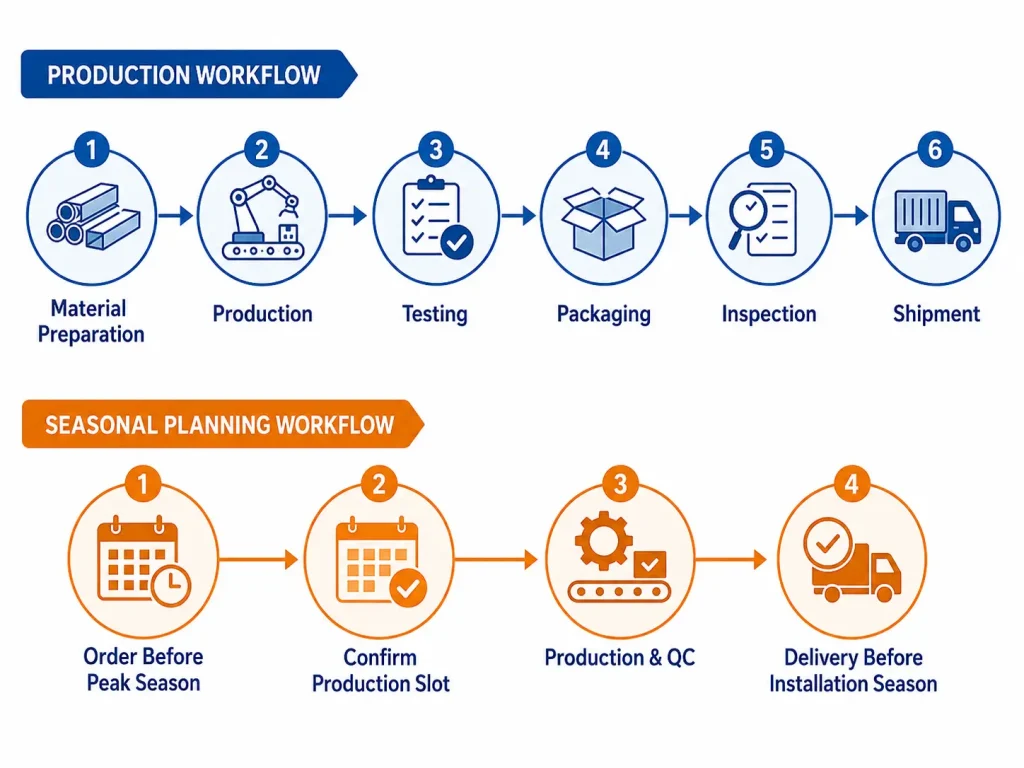
A landscape lighting manufacturer controls its own production schedule. After the order is confirmed, the factory can plan material purchasing, die-casting or machining, surface treatment, assembly, waterproof testing, aging tests, packaging, and shipment preparation in one workflow. For repeat buyers, the factory can also reserve capacity earlier based on forecast orders or seasonal purchasing plans.
A trading company depends on the production capacity of its partner factories. If the factory is fully booked, short of materials, or prioritizing other direct customers, the trading company has limited ability to change the production queue. This risk becomes higher for customized finishes, private-label packaging, special cable lengths, or non-standard voltage requirements.
For standard products with ready stock, a trading company may still ship faster. But for planned wholesale orders, customized products, or seasonal replenishment, working directly with a manufacturer usually gives buyers clearer production visibility and better delivery control.
6. Warranty, Replacement Parts, and Long-Term Support
Warranty support in landscape lighting is not only about promising a certain number of years. It also depends on whether the supplier can provide the same components, finishes, accessories, and technical support after the original shipment.
For example, if an imported batch of integrated LED spotlights starts showing failures after two or three years, the buyer needs more than a general apology or discount on the next order. They may need matching replacement drivers, LED modules, lenses, gaskets, stakes, connectors, or updated installation guidance. A landscape lighting manufacturer is usually better positioned to handle this because it has access to production records, component specifications, tooling, and previous order details.
A trading company may also help with warranty claims, but it often depends on the original factory’s cooperation. If that factory stops producing the model, changes components, or no longer works with the trading company, finding an exact replacement can be difficult. A similar-looking fixture may have a different color temperature, beam angle, driver, cable, finish, or mounting accessory.
For wholesalers, this can affect customer trust. If you sell a product line under your own brand, your customers expect consistent replacements and clear warranty handling. Long-term support is therefore not just after-sales service; it is part of product line stability.
When a Manufacturer Is the Better Choice
A landscape lighting manufacturer is usually the better choice when your business depends on stable supply, consistent quality, private-label development, and long-term cooperation.
You should consider working directly with a manufacturer if:
You are a wholesaler, importer, distributor, or lighting brand with repeat orders.
You need private-label packaging, OEM branding, or customized product specifications.
You require consistent product quality, finish, color temperature, and accessories across batches.
You want better control over materials, waterproof structure, cable standards, connectors, and packaging.
You need technical documents to support your sales channels, such as specification sheets, installation guides, IES files, or testing reports.
You want more transparent pricing for long-term wholesale planning.
You need long-term availability of spare parts, replacement accessories, and warranty support.
You care about production traceability and supplier accountability.
Manufacturers are especially suitable for buyers who want to build a stable landscape lighting product line instead of making one-time purchases. For importers, wholesalers, and lighting brands, a stable product line requires consistent appearance, color temperature, waterproof performance, packaging, accessories, and installation support across every repeat order.
Working with a manufacturer may require more communication in the beginning, especially around samples, specifications, packaging, and quality requirements. But once the cooperation becomes stable, it can provide better long-term value, stronger product consistency, and more reliable support for your own sales network.
Global Manufacturing Powerhouse
Partner with a Global Leader in Landscape Lighting Manufacturing
$25M
Annual Output
300+
Global Brands
10D
Prototyping
Unlock exclusive margins and stable supply with our 250,000+ sq.ft factory. Professional ETL/UL certified quality guaranteed.
A trading company may be more suitable in certain situations, especially for buyers who value convenience, product variety, and lower initial inventory pressure.
You may consider working with a trading company if:
You are testing a new market and do not want to commit to a high MOQ.
You need small quantities across many different product categories.
You want to combine fixtures, transformers, cables, connectors, and accessories in one order.
You do not have clear technical requirements yet.
You need ready-made products quickly.
You prefer one supplier to coordinate multiple factories.
You are not ready for OEM branding, private-label packaging, or custom product development.
For new importers or early-stage distributors, trading companies can sometimes reduce the complexity of sourcing. Instead of contacting several factories, comparing samples, and coordinating different shipments, you can work with one trading company to collect multiple product types.
However, you should still evaluate the trading company carefully. A good trading company should be transparent about its role, clear about product sources, and capable of managing basic quality control.
The risk is not that a supplier is a trading company. The real risk is when a trading company pretends to be a manufacturer, hides product sources, or cannot provide reliable after-sales and replacement support.
Red Flags: How to Verify If a Supplier Is a Real Manufacturer
Many suppliers call themselves manufacturers, but the real question is simple: do they actually control production?
For importers and wholesalers, this matters because the company that controls production is usually the one that controls product quality, lead time, customization, and warranty response. Before placing a serious order, use the checks below to understand who you are really working with.
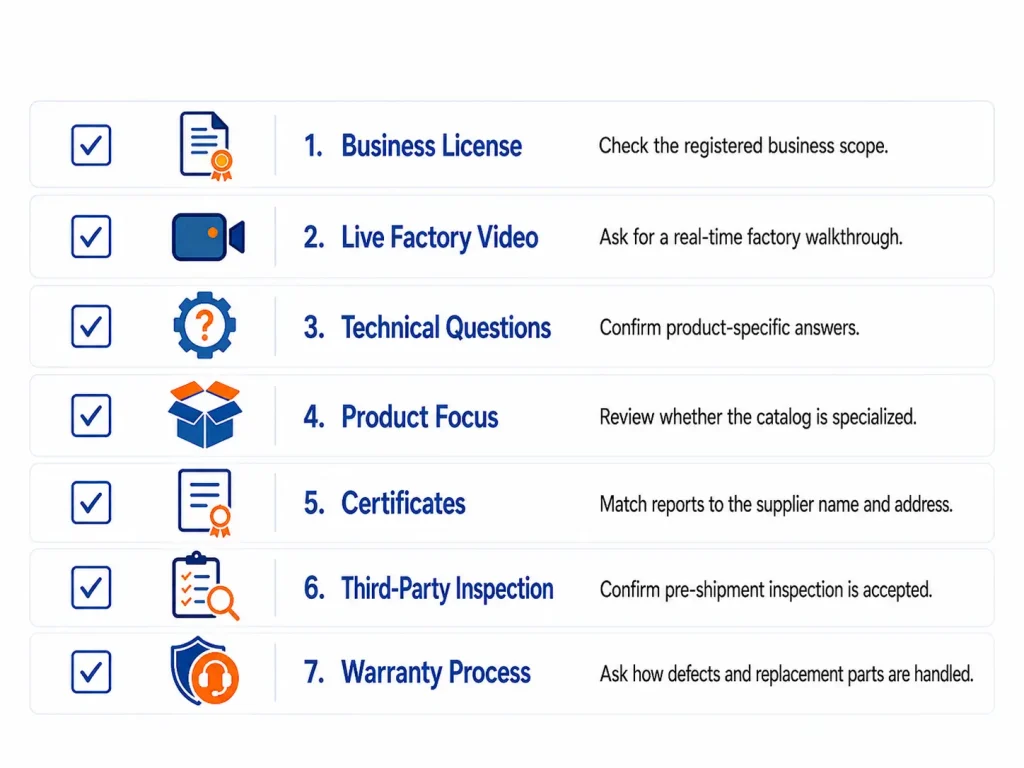
Check the business license and business scope
Ask for the supplier’s business license and look at the registered business scope. A manufacturer will usually include words related to the manufacturing, processing, or production of lighting products. If the scope mainly mentions trading, wholesale, import/export, or consulting, the supplier may be a trading company. That is not always a problem, but it should be clear from the beginning.
Ask for a live factory video call
Factory photos and polished videos are easy to prepare. A live call is harder to fake. Ask to see the areas that matter for landscape lighting production, such as raw material storage, machining or die-casting, assembly lines, waterproof testing, aging tests, packaging, and finished goods inspection. A real factory should be able to walk you through these areas and explain how the product is made.
Ask technical questions about a specific product
Do not only ask general questions. Pick one model and ask about the housing material, surface treatment, LED chip, driver, waterproof structure, cable type, connector, beam angle, color temperature, and testing process. If the supplier can answer directly, that is a good sign. If they keep saying they need to “check with the factory,” they may not be the factory.
Look at the product range
A landscape lighting manufacturer usually has a focused product line: path lights, spotlights, in-ground lights, deck lights, wall wash lights, transformers, cables, and related accessories. If the same supplier also sells furniture, household appliances, holiday decorations, and unrelated electrical tools, it is more likely a sourcing or trading company.
Compare certificates with company information
If the supplier provides ISO, ETL, CE, RoHS, SGS, Intertek, or other reports, check the company name and address on the documents. They should match the supplier you are dealing with, or the supplier should clearly explain the relationship. If all certificates belong to another company, you need to know who actually makes the products and who takes responsibility if something goes wrong.
Confirm whether third-party inspection is accepted
A reliable supplier should accept reasonable pre-shipment inspection. This may include checking quantity, appearance, packaging, labeling, basic function, and sample-based quality requirements. If the supplier refuses inspection or keeps avoiding the topic, treat it as a warning sign.
Ask how warranty and replacement parts are handled
A warranty is only useful if the supplier can support it later. Ask how they track production batches and whether they can provide replacement drivers, LED modules, lenses, stakes, connectors, cables, or gaskets if problems happen after shipment. A factory that controls production is usually better able to trace issues and provide matching parts.
The purpose is not to avoid every trading company. Some trading companies are honest and useful for mixed orders. The point is to know the supplier’s real role before you commit—who makes the product, who controls quality, and who will help you when problems appear after delivery.
Final Thought
In the landscape lighting industry, there is no universally correct supplier type; there is only the supplier type that aligns with your operational capabilities and capital scale. For scaling importers and well-capitalized wholesalers, building direct factory partnerships is the ultimate path to capturing maximum market share, securing pricing dominance, and ensuring product reliability. For agile distributors focused on rapid catalog diversification and low financial exposure, a highly professional trading company offers unmatched logistical efficiency. Assess your volume, define your risk tolerance, and audit your suppliers thoroughly to build a resilient, profitable lighting supply chain.